Flowers Worthy of Adoration, Bearing the Name of Her Majesty Queen Sirikit The Queen Mother
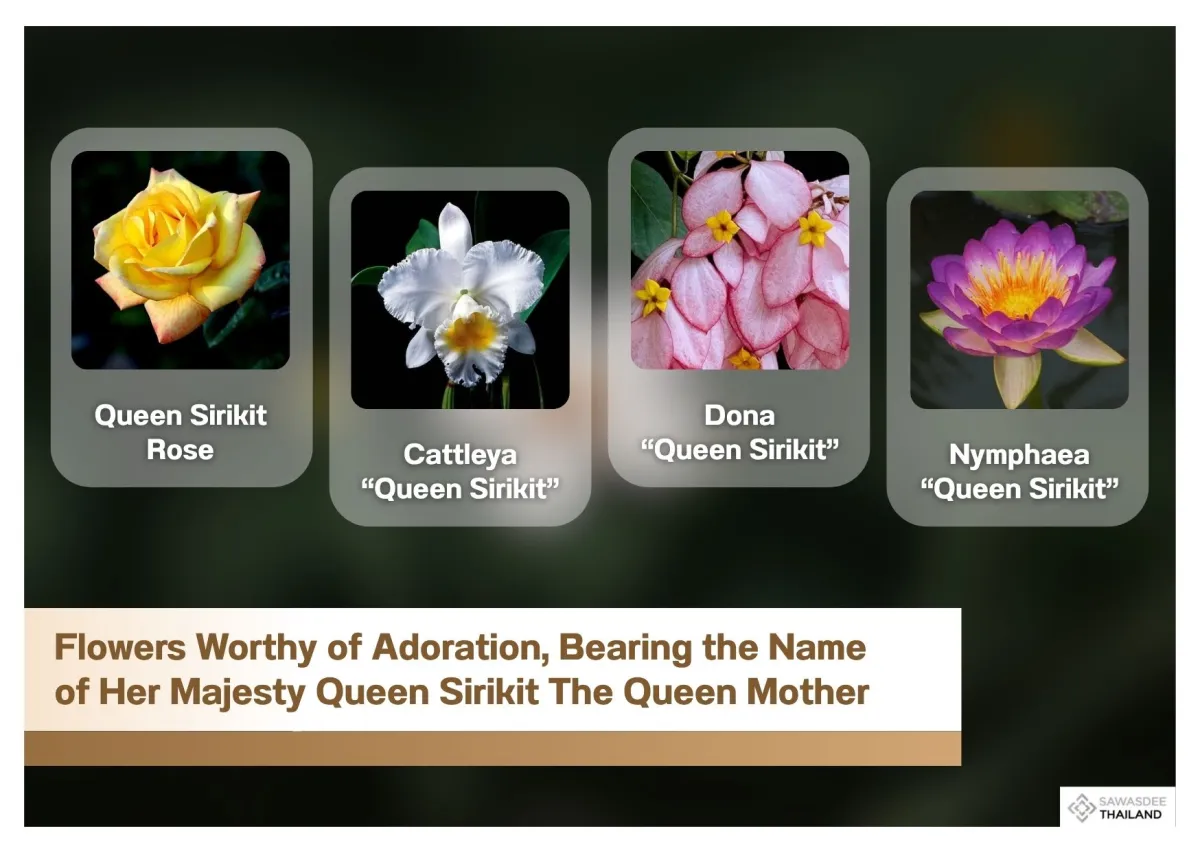
Concerned about the degradation of the natural environment, Her Majesty Queen Sirikit The Queen Mother lent her support to the conservation of natural resources and the environment. Her Majesty’s efforts to conserve flora gained worldwide recognition, and when new plants were discovered, several international botanical organizations worldwide sought royal permission to name the plants after Her Majesty in her honor. The plants would also represent Her Majesty’s grace and beauty existing together with the natural world. Four major plant species named after Her Majesty Queen Sirikit are described, as follows:
🌸 Queen Sirikit Rose
One of the most famous and beautiful flowers in the world, the Queen Sirikit Rose (Rosa “Queen Sirikit”), has a lively yellow color that turns into a yellowish orange in the sunlight. This hybrid tea rose has a gentle fragrance. It was developed from a cross between orange hybrid tea, “Königin der Rosen,” and yellow hybrid tea, “Golden Giant.” The cross-breeding created a new variety, known as “Peer Gynt.” The Queen Sirikit Rose won the first prize in a rose competition in Belfast, Northern Ireland, in 1970.
Later, Mr. André Hendrickx, Director of Grandes Roseraiea du Val de Loire in France, asked permission from Her Majesty Queen Sirikit to name the rose after her in August 1971, when King Bhumibol Adulyadej and Queen Sirikit paid a visit to Denmark.
🌸 Cattleya “Queen Sirikit”
Cattleya “Queen Sirikit” is a hybrid orchid, with pure white petals exhibiting golden-yellow throats. It was produced and registered in 1958 by Black and Flory, a long-standing orchid company in England. The company asked royal permission to name the flower Cattleya “Queen Sirikit” in honor of Her Majesty Queen Sirikit.
This orchid variety received the Award of Merit from the Royal Horticultural Society in England. Later, Her Majesty granted permission for the use of this crossbred orchid as the flower of the Thai Women’s Day, which is observed on 1 August each year to promote the vital roles of Thai women.
🌸 Dona “Queen Sirikit” (Mussaenda philippica A. Rich cv. Queen Sirikit)
The Dona “Queen Sirikit” produces small, star-shaped, yellow flowers surrounded by pink bracts. It is a hybrid created by the University of the Philippines in 1963. When His Majesty King Bhumibol and Her Majesty Queen Sirikit visited the Philippines, the university sought royal permission to name this plant after Her Majesty the Queen in her honor and in order to strengthen friendly relations between Thailand and the Philippines.
The Dona “Queen Sirikit” is a scandent shrub, known to grow to about 1-3 meters high. The leaves are oval shaped with a pointed end and sometimes hairy underside. The flowers are bright yellow surrounded by pale pink bracts with red edges.
🌸 Nymphaea “Queen Sirikit”
Nymphaea “Queen Sirikit” is a hybrid water lily, a cross between a temperate US variety and a tropical Thai variety. It produces a unique petal color pattern. The inner petals are white with purple tips, and the outer petals are greenish-white. The flower has a vibrant yellow center, and it has purple-blue color at the tips of the petals. The cross-breeding created a new color that has never existed before in the temperate zone.
The hybrid water lily blooms in the morning and closes in the evening. It usually blooms for about three days. Owing to its beauty and distinctive features, the Botanical Society of Thailand on 11 June 2012 asked permission from Her Majesty Queen Sirikit The Queen Mother to name the water lily after her in honor of Her Majesty on the occasion her 80th birthday anniversary.
These four flowers are beautiful not only in form but also in meaning. They represent Her Majesty’s loving-kindness, wisdom, and interests in conserving natural resources, thus leading to the preservation of the natural world and its beauty forever.