IMF Launches the 2026 Financial Sector Assessment Program (FSAP), Targeting Digital and AI Risks While Highlighting "Greece" as a Crisis Recovery Model
IMF Launches the 2026 Financial Sector Assessment Program (FSAP), Targeting Digital and AI Risks While Highlighting "Greece" as a Crisis Recovery Model
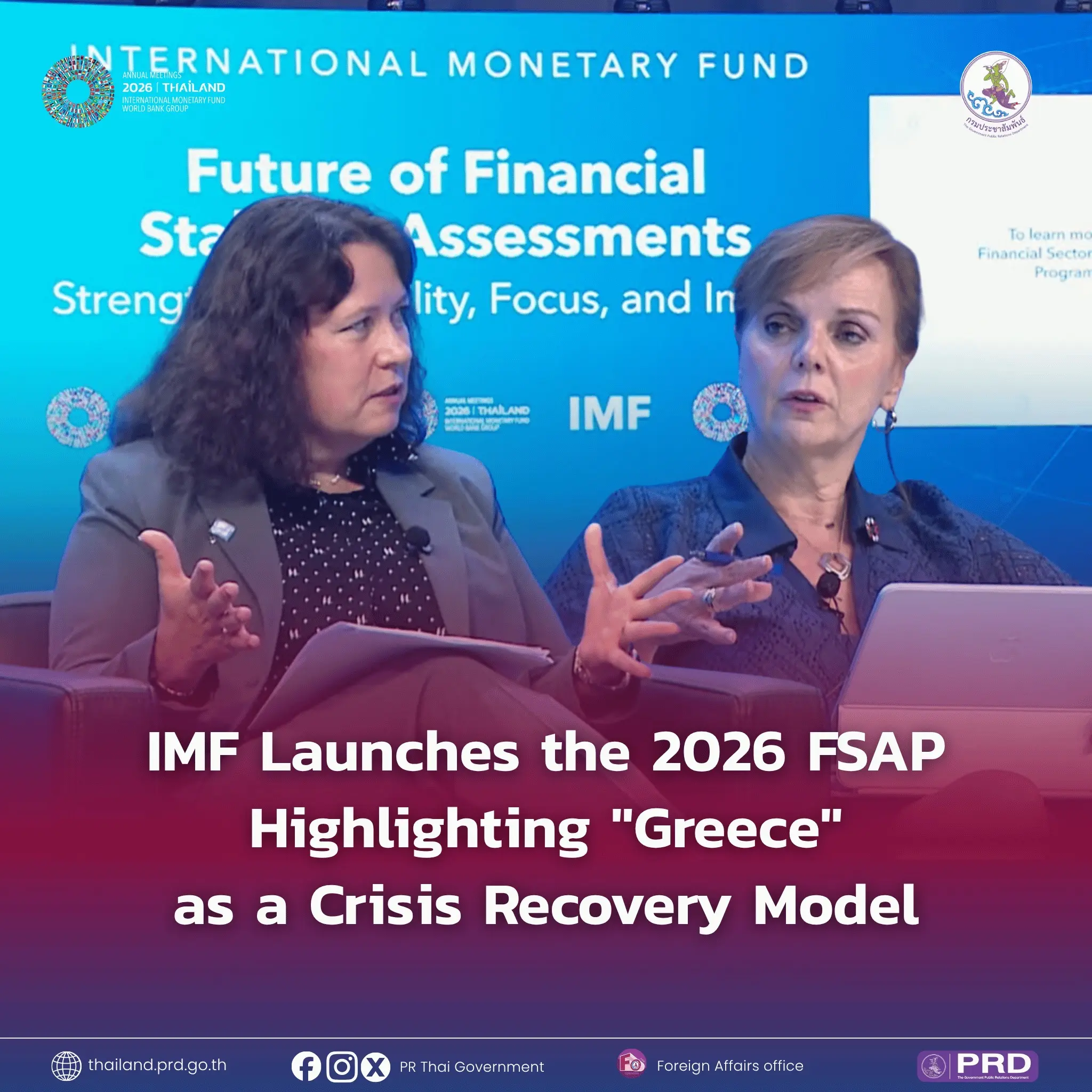
On October 17, 2026, at 2:00 PM at the Queen Sirikit National Convention Center, a panel discussion titled "Future of Financial Stability Assessments: Strengthening Agility, Focus, and Impact" was held during the 2026 IMF-World Bank Group Annual Meetings. The event marked the public launch of the 2026 update to the Financial Sector Assessment Program (FSAP). Led by Michaela Erbenova, Deputy Director of the IMF's Monetary and Capital Markets Department, and Christina Papaconstantinou, Deputy Governor of the Bank of Greece, the discussion focused on the financial sector's need to adapt to emerging risks, such as digital technology and the increasing interconnectedness of financial institutions.
Christina shared the experience of Greece, which recently underwent its first mandatory FSAP assessment in 20 years. Greece's banking sector has successfully recovered from its sovereign debt crisis and regained its strength, significantly reducing its non-performing loan (NPL) ratio—which once soared to around 50%—down to Eurozone standard levels and reclaiming its investment-grade status. The IMF's assessment arrived at an opportune time, helping to highlight the closure of legal loopholes, the improvement of the insolvency framework, and the management of private debt. Today’s world faces multidimensional risks, including geopolitical tensions, inflation, and climate change. Another critical issue discussed was artificial intelligence (AI) and cyber threats.
Michaela pointed out that the IMF prioritizes assessing "operational resilience" to ensure that regulatory authorities possess the understanding and tools necessary to cope. Christina added that the ultimate goal is not merely for a single institution to survive a cyber threat, but for the entire financial system to be able to absorb the impact and withstand these threats collectively.
Furthermore, for emerging markets and developing economies, the IMF will collaborate with the World Bank to assess both financial stability and development simultaneously. The recommendations will be tailored to align with political constraints and implementation timelines, ensuring that national authorities can effectively put them into practice.
The FSAP has served as a crucial tool for the IMF and the World Bank for over two decades in assessing the financial risks and stability of various countries. The 2026 update of the program aims to make the process more agile, focused, and impactful within a rapidly changing financial landscape. It centers on four main areas: risk-tailored Scope, practical Traction, Efficiency, and member country Participation.